
Introduction
Men’s dress watches are a sophisticated variety of wristwatches used to accessorize formal and semi-formal clothing. This variety of a watch clearly works on the principle of keeping things simple, balanced, and elegant rather than fashionable.
Previously, men used dress watches for special occasions like black tie events,formal suits. Times changed so did the way people viewed fashion. In 2026, it is not uncommon to find that a man Watch is comfortably adaptable to business attire, corporate settings, weddings, office meetings, and luxury dinners, and can even form part of smart‑casual attire
From a professional fashion perspective with regards to watches and leathers, the value of the dress is in its materials and dimensions. A thin case easily slips under a shirt cuff. A simple, uncluttered face signifies intelligence and adultness in a man.
History & Origin
The mens dress watch has a long and dignified history, much like clothing itself. To understand its importance, however, we must look back and briefly learn about the evolution of timepiece wear from necessity to personal expression.
Before Wristwatches: The Pocket Watch Era
Prior to the 20th century, watches were mostly carried as pocket watches by gentlemen. These pocket watches were quite fashionable, engraved, and resembled chains.
Early 1900s: The Emergence of the Watch
Wrist watches were gradually replacing the pocket watches in the early 1900s. These, first popularized among the military because of their convenience. The gentlemen of Europe, particularly in Switzerland, France, and the UK, wore slim and compact timepieces that could fit in beneath their tailoring shirt cuffs.
1920s–1930s: Formal Design Takes Shape
The interwar years set the agenda for the classic modern style of the “dress watch.” The proportions and simplicity favored by during that time included the following:
- Round, slim cases
- Clean dials with minimal text
- Roman numerals or baton indices
- Manual mechanical movements
Post‑World War II: Craftsmanship & Prestige
The popularity of mechanical watches followed World War II. The Swiss perfected their watches, their accuracy, and their finishing.
1960s–1980s: The Quartz Revolution
The introduction of the quartz movement changed the entire industry. Watches were now more accessible, accurate, and affordable. Dress watches retained their traditional aesthetic appeal and became more accessible.
Modern Era: Tradition Meets Innovation
Watches of contemporary manufacturers possess the modern characteristics while maintaining the traditional aspects of conventional rules offer additional features like lightness, thinness, eco-friendliness, and comfort in the straps.
Classic Rules That Still Matter
Slim case profile
Balanced dial layout
Leather strap or refined metal bracelet
Timeless proportions
Dress Watch vs Other Watch Styles
Many men get confused between dress watches and other types of watches. Knowing the differences helps you select the right watch for the right occasion.
What Makes a Dress Watch Unique?
| Feature | Dress Watch | Sports / Casual Watch |
| Design | Minimal, elegant, understated | Bold, rugged, expressive |
| Thickness | Slim (8–11mm) | Thick (12–16mm) |
| Complications | Time, date | Chronograph, GMT, diver |
| Strap | Leather or fine metal | Rubber, NATO, steel |
| Usage | Formal, business | Outdoor, casual, sports |
Key Features of a Great Mens Dress Watch
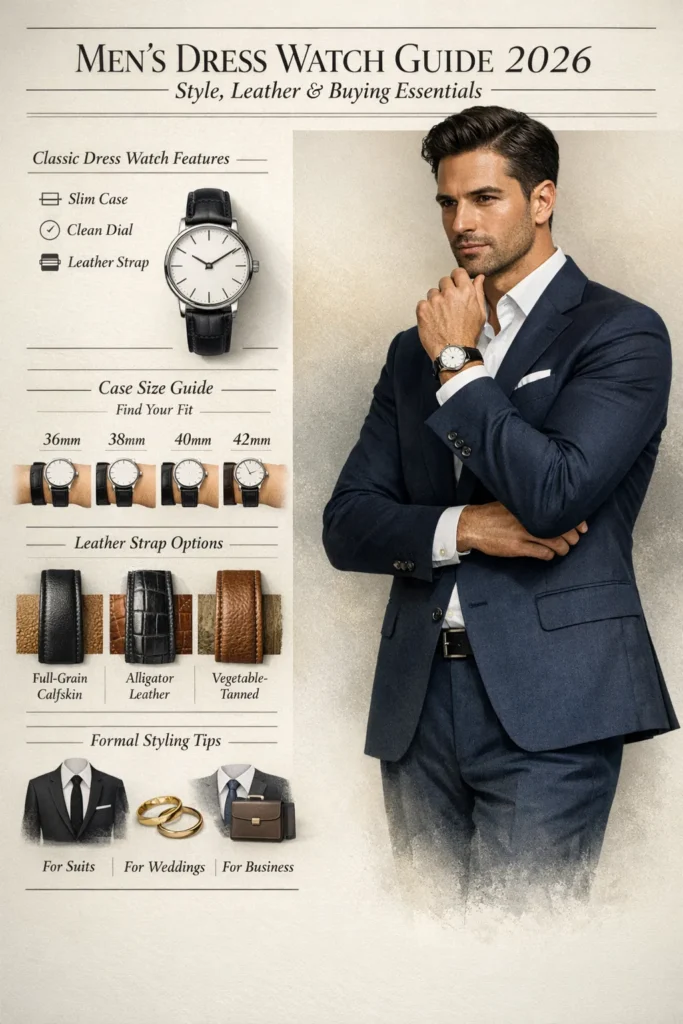
Slim Case Profile
A good dress watch must slide smoothly under your shirt cuff. Thickness is more important than the watch’s diameter.
- Ideal thickness: 8–11mm
- Ultra‑thin models: 6–8mm
Clean & Balanced Dial
The dial should convey clarity at a glance..
Common elements include:
- Simple hour markers
- Roman numerals or baton indices
- Minimal branding
- Neutral color palettes
Overcrowding of the dials lowers.
Quality Leather Strap
The strap, from the leather expert’s point of view, determines the personality of the watch.
Best leather options:
- Full‑grain Calfskin – durable, breathable, ages gracefully
- Vegetable‑tanned leather – develops a rich patina
- Alligator or crocodile – formal luxury
Avoid:
- Synthetic leather
- Cheap bonded materials
- Overly stiff straps
Proportional Case Size
| Wrist Size | Ideal Case Size |
| Small | 36–38mm |
| Average | 38–40mm |
| Large | 40–42mm |
Materials & Fabrics Used in Mens Dress Watches
Case Materials
- Stainless steel: Durable, versatile, timeless
- Gold / Rose gold: Luxury, warmth, prestige
- Titanium: Lightweight, modern, hypoallergenic
Dial Materials
- Enamel – classic and refined
- Sunburst metal – dynamic elegance
- Matte lacquer – modern minimalism
Leather Straps
| Leather Type | Quality | Best For |
| Full‑grain calfskin | ★★★★★ | Classic elegance |
| Alligator / Croc | ★★★★★ | Formal luxury |
| Top‑grain leather | ★★★★☆ | Daily wear |
| Synthetic | ★★☆☆☆ | Avoid |
Styles & Variations of Mens Dress Watches
Classic Dress Watch
- Time‑only display
- Slim leather strap
- Pure elegance
Date Dress Watch
- Discreet date window
- Practical yet formal
Small Seconds Watch
- Vintage inspiration
- Distinctive character
Ultra‑Thin Watch
- High‑end minimalism
- Precision engineering
Leather‑Strap Hybrid
- Business‑formal Versatility
- Modern refinement
Occasions
Business meetings
- Weddings & receptions
- Formal dinners
- Office environments
- Smart‑casual gatherings
Countries & Cultures
- Switzerland: Watchmaking heritage
- France: Elegant minimalism
- Italy: Fashion‑driven luxury
- United Kingdom: Traditional formality
- Germany: Bauhaus precision
Dress watches symbolize cultivated masculinity across Europe and beyond.
Latest Trends & Modern Updates (2026)
- Sustainable leather straps
- Cream, champagne, and grey dials
- Slim steel bangles
The modern man’s dress watches pay homage to tradition, yet they hold on tight to progress.
How to Style a Mens Dress Watch
Match Leather Correctly
- Black strap → Black shoes & belt
- Brown strap → Brown shoes & warm tones
Outfit Pairing
- Suits: Leather strap
- Business casual: Brown leather or slim steel
- Weddings: Gold or polished steel
Accessories
- Match watch metal with cufflinks
- Avoid oversized cases with suits
Buying Guide
Step‑by‑Step Checklist
- Measure wrist size
- Choose movement type
- Inspect leather quality
- Confirm case thickness
- Set a realistic budget
Budget Guide
| Budget | What to Expect |
| Under $200 | Quartz, basic elegance |
| $200–$500 | Quality leather, trusted brands |
| $500–$1000 | Automatic movements, heritage feel |
| Luxury | In‑house movements, premium leather |
Pros & Cons
Pros
- Timeless appearance
- Enhances formal outfits
- Lightweight comfort
- Long‑term style value
Cons
- Not suitable for sports
- Leather requires care
- Few complications
Care & Maintenance Tips
- Avoid water exposure on leather
- Rotate watches regularly
- Store in a dry environment
- Service mechanical watches every 3–5 years
- Clean the leather with a soft, dry cloth
FAQs
A:Men should opt for 38-40mm, depending upon their wrist size.
A:Yes, it matches with business or even smart casual clothing.
A:When it comes to formal wear, leather is considered more formal.
A:One looks to quartz for reliability and accuracy.
A:Proper care: 1 to 3 years, depending on usage.
Conclusion
“A men’s watch is more than just a timepiece. It is a symbol of discipline, elegance, and quiet confidence.” Even a functional quartz or mechanical timepiece is made more elegant with a well-chosen dress watch.
From a fashion and leather expert’s viewpoint, the focus will always be on proportion, quality and comfort of straps, and Minimalism. After all, a slim case, a clean face, and a genuine leather strap would never go out of fashion.
